Private by default
Nothing is captured until you enable a channel, and DMs never are. The archive sits behind an administrator login, published nowhere. When a message is deleted on Discord it is deleted here too, and the deletion is written down.
 OpenConvo
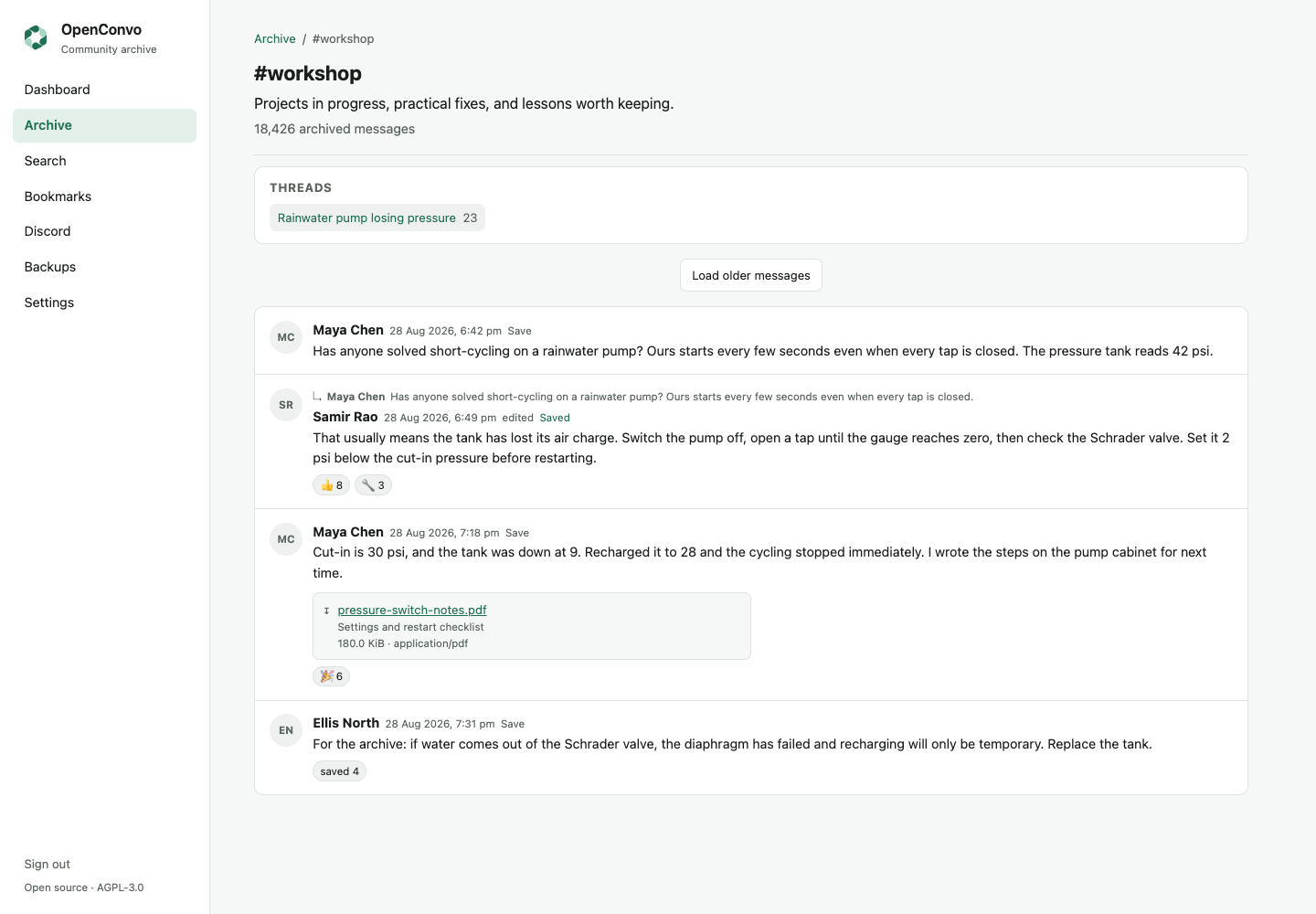
OpenConvo is for the person who runs a Discord community, for an open-source project, a hobby or a game, and has watched the same question get answered for the fifth time, knowing the good answer is somewhere in the scrollback. Connect a bot, pick the channels worth keeping, and OpenConvo archives their full history and stays in sync. When someone asks again in two years, the answer is still there, with the conversation around it.
All you need is Docker with Compose, on any host that can run two small containers. A 1 GB VPS is fine.
git clone --branch v0.1.2 --depth 1 https://github.com/openconvo/openconvo
cd openconvo
./scripts/install.sh
The installer asks for credentials only for the features you turn on, then starts OpenConvo. Read the installation guide, or verify the published image before you run it.
Would rather not run a server? Email me and I will run it for you.
Nothing is captured until you enable a channel, and DMs never are. The archive sits behind an administrator login, published nowhere. When a message is deleted on Discord it is deleted here too, and the deletion is written down.
Messages, edits, deletions, reactions, threads and attachments, in your PostgreSQL and on your own disk or bucket. Checksummed JSONL and Markdown exports and scheduled off-site backups keep it useful even if Discord, OpenConvo or its maintainers disappear.
Boring to run: one Go binary plus PostgreSQL, deployed as two containers with Docker Compose. No Kubernetes, no Redis, no required external services.
The open-source edition is the whole product: capture, browse, search, curate and export, with optional semantic search and a read-only MCP endpoint for your own AI tools. Want a public Discord findable on Google? That is a different job, and the comparison page says which tools do it well.
This is early software: expect rough edges, keep verified backups, and read the known limitations in the roadmap first. Archive only servers you run, and tell your members which channels are kept and who can read them.